I love language. I love communication. I love writing and talking. I enjoy words, their meanings, their roots, and how they fit into our lives and how we get our messages across to each other. When I first embarked on my anthropology degree, I wanted to be a Linguistic Anthropologist. Unfortunately, the university I went to didn’t offer that so I chose Cultural Anthropology and loved it. Language and culture go hand in hand and the more I got into my studies the more I enjoyed it. But in the long run, it didn’t matter since I quit school two semesters shy of my degree. But that’s a story for another time.
I think I’ve been to fifteen different countries. Some as a military dependent, some as a Soldier, and one or two just because. I have always liked learning about other cultures and I try to pick up a few words of their language when I’m there. Usually, “Hello,” “Thank you,” “Please,” and phrases like that. I think India was the most interesting place I have ever been. The different cultures I encountered within that country drew me in and the amazing and colorful people there fascinated me. The languages they spoke were different from anything I had heard. Yes, languages. The statistic I found states that India has 29 individual languages that are each spoken by at least one million people. There are many others languages that weren’t listed because the site said not as many people speak them. As many as 100 languages are spoken in India daily.


Our interpreter spoke four languages which helped us greatly in our travels. However, we did end up visiting a village on a beach on the Bay of Bengal that had been devastated by the Tsunami of 2004 and our interpreter didn’t speak their local language. We interacted with the people there, but we could not fully communicate. We had no idea what the locals were telling us but it was no doubt how their village was forever changed by devastating waves. In a later event, the interpreter was keeping up brilliantly in translating a sermon given by the leader of our group. Right up until he said, “You can’t teach an old dog new tricks.” The interpreter looked right at the speaker and said, “Beg your pardon?” That phrase had no adequate translation to Telugu, the language of the people we were speaking to. This intelligent, very well-educated translator could not convey the simple phrase “You can’t teach an old dog new tricks.” He knew the words and what each word meant. But they had no meaning grouped together in that order in the translated language.


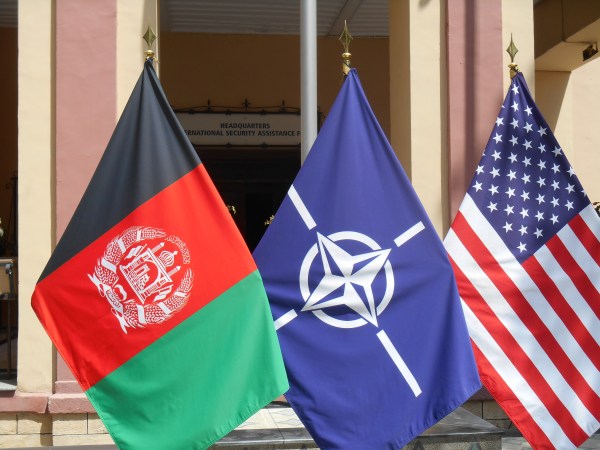
While deployed to Afghanistan, one of my favorite places I got to visit was the ISAF Headquarters base (International Security Assistance Forces). It was very close to the base where I was stationed at in Kabul. It was also connected to the U.S Embassy which was very cool to visit. I probably went on ten missions to ISAF. Most of the countries that were participating in the war effort had troops at ISAF Headquarters. I really enjoyed interacting with coalition and NATO forces. All of us from different cultures speaking a different a tongue, but on a common mission. I’m proud of the Bronze Star I received while there, but I think my favorite ribbon on my uniform is the NATO ribbon. It shows that I was part of something bigger than all of us, even if we couldn’t always understand each other.
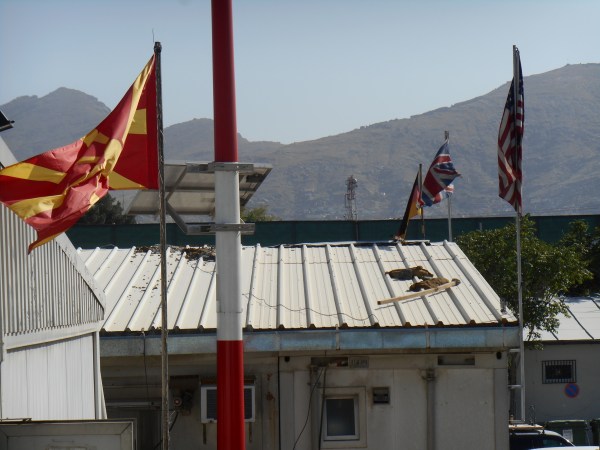
And of course, with that many troops from that many different countries there were some language and communication issues. Most notably, and to be honest the most entertaining to me, was a conversation I watched between two Service Members from different countries (one was Italian and I can’t remember the other). Both men spoke some English, enough to be able to talk to me for the most part. But their broken English was not good enough to talk to each other and it was the only language they had in common. They were actually arguing about something in broken English, not getting anywhere with each other. I was no help because I couldn’t figure out what their disagreement was. But it was amusing to me. Sorry, I find things funny sometimes that aren’t always funny to others.


Speaking the same language does not always mean two people can understand or effectively communicate with each other. Sure, one might know the words that are being spoken, but he might not understand the meaning of what is being said. That’s a hard concept to grasp. Even as I write this, I’m trying to figure out what I’m saying, trying to say it in a way that is logical to you. It should makes some sense, then, that people get upset when arguing. A person understands the definition of each word being said, but he can’t grasp the concept behind all the words together, in the order they come, or the meaning portrayed by the speaker. Perhaps the speaker should say them louder and be more animated, maybe that will help. And, that’s how the fight starts. I think I do that sometimes when trying to describe my PTSD to people who cannot comprehend or begin to understand. It’s frustrating. I know it’s not from lack of trying. But people who have never experienced what’s going on in my mind, can’t fully understand what I say when I talk about it. Much like the two Service Members from different countries trying to figure out their problem. And no different than the locals on the beach in India that we could not understand at all.
But I still love language. I love putting all the words together and giving them meaning and feeling. Whether you understand me or not has no bearing on what I write. I’m doing this for my own good, for my own therapy. I do hope you enjoy it and get something out of it. I always appreciate feedback, good or bad. Mostly, I hope you have a better understanding of what many of us struggle with daily. We are doing our best to communicate, but it’s hard sometimes, especially when often times we are not understood.
Thanks for reading. Good day, God bless.
Dave
 Story of My Life