2nd Excerpt From My Book

I got nothing this week. Except anger, pain, and horribly dark thoughts. However, I will not have a meltdown in the blogosphere that I did a month or so ago. I thought about skipping this week and not making a post. Instead I will share a second excerpt of the book I am writing. For the other update I posted from Chapter 3, you can find it here: https://davidegeorge.wordpress.com/2016/07/23/448/.

In this part from Chapter 5, the main character, James, is in the middle of telling one of the stories of his war experiences to the psychologist during his stay in the psych ward at the hospital. I am slowly, but surely working on my book. I have added some content since the last excerpt, but mostly have cleaned up and re-written much of the first five chapters. I would like to finish by the end of October. We’ll see if that happens. I hope you enjoy the small part of the book here. All feedback welcome. Thank you for reading. Good day, God bless.

Dave


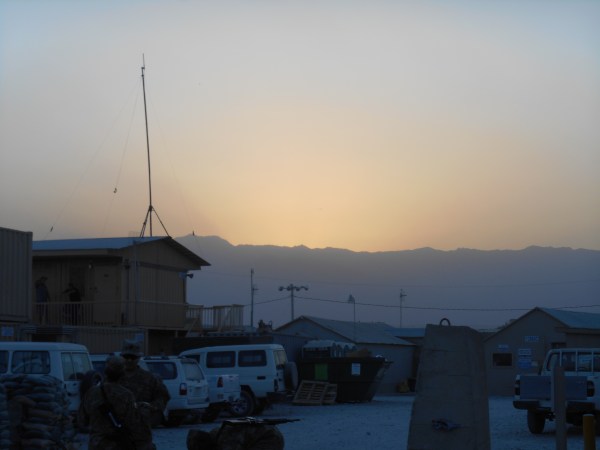
One day when James was by himself in the office the warning sirens sounded as the first explosion shook the small building. James calmly, but with purpose, grabbed his gear. James could tell from experience that this blast wasn’t dangerously close, but close enough to get his attention. This was nothing new to him. He had been there for four months at the time and had probably heard over 200 explosions that originated from somewhere in the mountains. James and the others had become pretty good at approximating how far away the blasts were by the sound it produced and the shaking of the building. Most of the time the enemy was aiming for the airstrip, which was fairly close to their office, but far enough away that if the first blast didn’t get the small building, anything that followed would generally be getting farther away.

Before James could exit the building to take refuge in a nearby concrete bunker, the second explosion hit surprisingly close. This one shook the building with more force, causing books and DVDs on shelves to fall to the floor. James ran out the door with his weapon and protective gear and got in the bunker. He sat in the dirt and leaned up against the wall listening to the sirens and voices over the broadcast system. Looking back and forth out both sides of the bunker James noticed there was no one else around him. He was alone in the bunker. He wondered where his two office mates were and where on the base the last rocket fell. James knew it had definitely landed somewhere close, closer to him than any previous blast had landed.

The third explosion felt like it was right on top of him. It crossed his mind that he might become a statistic, a number on the list of those that never made it home. But then it occurred to him, he would still go home, just zipped up in a bag instead, that is, if they could find all the pieces. James knew the enemy was ‘walking them in.’ They would fire a rocket, mark where it lands, make adjustments, and fire again getting closer to the intended target. Based on the sounds of the first three explosions, James believed in his mind that if they got off a fourth rocket, it would land right on top of him. James waited alone in the bunker with only his thoughts. The noise from the broadcast system, still blaring the warnings as loud as it could, faded in his mind. He could only hear his heart beating and a couple voices in his head. He thought about his brother Bobby grilling him a few years ago about why anyone would want to join the military knowing they would go to war and possible get killed. This thought presented quite a quandary to him. James thought that maybe Bobby was right, but if James died Bobby wouldn’t be able to tell him, “Told you so,” like he always did when they were kids. James smiled a little at this catch-22 of a situation he found himself in. Then he thought of Donna and the possibility of never seeing her again. His smile quickly faded.

There was not to be a fourth explosion on that day. The sirens eventually stopped and were immediately replaced with a loud voice telling the base personnel what areas were now safe to resume movement. Sectors two and three were to stay put, but the area James was in was cleared by the big voice and those in that area could return to normal duty. He wondered where his co-workers were and hoped they were safe. James walked out of the bunker and headed back to the small building he had evacuated a short time ago. Though it felt like hours stuck in the bunker, in reality it was only about twenty-five minutes. He didn’t notice any damage to the outside of the building as he surveyed the area before entering, but saw the mess of books and DVDs that littered the floor inside from the shaking of the building. James sat back down at the main desk, picked up the phone to see if it worked, and logged on to the computer. He would give the other guys a few minutes to get back before he checked in for accountability with the unit. It was Sergeant Jacobs’ job anyway, but if he didn’t come back it would become James’ responsibility. James did not that responsibility, not this way. Miller came bursting through the door after a moment, startling James.

dscn3353

dscn3985


Write Your Own Story

Almost every day last school year, and so far this one, I have seen the same elderly couple walking when I drop my kids off at their respective schools. They seem to be in their early to mid-70’s, happily taking their morning walk which I imagine is part of a daily routine for them. They start at their apartment and walk about a mile down the road to a convenience store, or perhaps the grocery store I’m not sure, for morning coffee. They always have a coffee cup when I see them on the way back. Sometimes they have a plastic grocery bag on the way back from their trip to whichever place it is that they go. Some days they have an umbrella that woman uses when it rains. The man walks the same, rain or shine. He doesn’t seem to care if he gets wet.

The elderly couple and I wave to each other, sometimes as many as three times each morning as I drive back and forth to my kids’ schools (4 kids, two different schools, at three different times every morning). I have never met the elderly couple, never stopped to exchange pleasantries. We have never actually spoken to each other. I will not likely stop to meet them, I think that would be weird. But I almost feel like I know them as many times as we have acknowledged each other in passing at 20 miles per hour. And since I don’t really know them, I have written their story in my own mind.

I have imagined what their names are, how they met, what they did for a living, how many children they had, grandchildren, places they have been, all kinds of things. Basically, I have made up the whole story of their life without even meeting the elderly couple, as I picture their story. Sounds weird, doesn’t it? It is almost like people watching, but to an extreme I guess. We have all sat at a mall, or airport, or the beach and watched people and imagined what they are like or what kind of life they live without even talking to them. Not just those places, but we also probably come up with a quick story in our minds for the guy on the corner holding a sign about being homeless. Or the jackass with Georgia plates on his car that does not know how to use his blinker. Or the recluse neighbor that never speaks to you.

It might seem silly to take the time to make up all those stories about people we do not know and have never spoken too. I have no idea why we do this. I know I’m not the only one that does this. And if we are completely honest, we make up a person’s back-story even if we do know them. Maybe we don’t know them very well or it’s a person we only see in passing at work or school and do not have the time to get to know them. I am certain people have come up with a story about me the same way I have for the elderly couple. Even some people that do know me have their own version of a story of me and my life and my decisions. But that’s ok. If they don’t know my whole story, they can make one up. I wonder if the elderly couple has a story for me. I wonder what it’s about. I wonder if it is a good story or if it’s more like, “Crap, here comes that guy again that waves at us every day, just wave and smile.”

They don’t know my story and I don’t know theirs. But I am telling mine to whomever wants to know it, right here every week. This marks 30 weeks in a row, after a two year break, that I have made a blog entry telling my story. My story the way I see it. The way I live it. My weekly posts have become my best therapy. Most of my entries has been real life events. A couple of times I posted some fiction that I’ve written. I have put a couple poems out there. But all of it, in some way, shape, or form, is part of my story. Part of my life. I am writing my story. I tried to write the ending once; but apparently my story was not over at the time.

We all have a story. Actually, we all have thousands of stories that make up a greater story. Who knows your story? Your real story? Tell it yourself so not as many people have to make one up for you. Thank you for looking at my story. Thank you for being part of the Story of My Life. Good day, God bless.

Dave

Language, War, and the Bay of Bengal

I love language. I love communication. I love writing and talking. I enjoy words, their meanings, their roots, and how they fit into our lives and how we get our messages across to each other. When I first embarked on my anthropology degree, I wanted to be a Linguistic Anthropologist. Unfortunately, the university I went to didn’t offer that so I chose Cultural Anthropology and loved it. Language and culture go hand in hand and the more I got into my studies the more I enjoyed it. But in the long run, it didn’t matter since I quit school two semesters shy of my degree. But that’s a story for another time.

I think I’ve been to fifteen different countries. Some as a military dependent, some as a Soldier, and one or two just because. I have always liked learning about other cultures and I try to pick up a few words of their language when I’m there. Usually, “Hello,” “Thank you,” “Please,” and phrases like that. I think India was the most interesting place I have ever been. The different cultures I encountered within that country drew me in and the amazing and colorful people there fascinated me. The languages they spoke were different from anything I had heard. Yes, languages. The statistic I found states that India has 29 individual languages that are each spoken by at least one million people. There are many others languages that weren’t listed because the site said not as many people speak them. As many as 100 languages are spoken in India daily.

Our interpreter spoke four languages which helped us greatly in our travels. However, we did end up visiting a village on a beach on the Bay of Bengal that had been devastated by the Tsunami of 2004 and our interpreter didn’t speak their local language. We interacted with the people there, but we could not fully communicate. We had no idea what the locals were telling us but it was no doubt how their village was forever changed by devastating waves. In a later event, the interpreter was keeping up brilliantly in translating a sermon given by the leader of our group. Right up until he said, “You can’t teach an old dog new tricks.” The interpreter looked right at the speaker and said, “Beg your pardon?” That phrase had no adequate translation to Telugu, the language of the people we were speaking to. This intelligent, very well-educated translator could not convey the simple phrase “You can’t teach an old dog new tricks.” He knew the words and what each word meant. But they had no meaning grouped together in that order in the translated language.

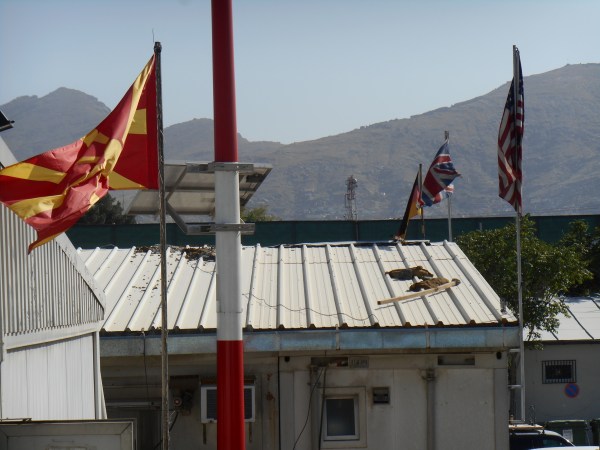
While deployed to Afghanistan, one of my favorite places I got to visit was the ISAF Headquarters base (International Security Assistance Forces). It was very close to the base where I was stationed at in Kabul. It was also connected to the U.S Embassy which was very cool to visit. I probably went on ten missions to ISAF. Most of the countries that were participating in the war effort had troops at ISAF Headquarters. I really enjoyed interacting with coalition and NATO forces. All of us from different cultures speaking a different a tongue, but on a common mission. I’m proud of the Bronze Star I received while there, but I think my favorite ribbon on my uniform is the NATO ribbon. It shows that I was part of something bigger than all of us, even if we couldn’t always understand each other.

DSCN3337

And of course, with that many troops from that many different countries there were some language and communication issues. Most notably, and to be honest the most entertaining to me, was a conversation I watched between two Service Members from different countries (one was Italian and I can’t remember the other). Both men spoke some English, enough to be able to talk to me for the most part. But their broken English was not good enough to talk to each other and it was the only language they had in common. They were actually arguing about something in broken English, not getting anywhere with each other. I was no help because I couldn’t figure out what their disagreement was. But it was amusing to me. Sorry, I find things funny sometimes that aren’t always funny to others.

Speaking the same language does not always mean two people can understand or effectively communicate with each other. Sure, one might know the words that are being spoken, but he might not understand the meaning of what is being said. That’s a hard concept to grasp. Even as I write this, I’m trying to figure out what I’m saying, trying to say it in a way that is logical to you.  It should makes some sense, then, that people get upset when arguing. A person understands the definition of each word being said, but he can’t grasp the concept behind all the words together, in the order they come, or the meaning portrayed by the speaker. Perhaps the speaker should say them louder and be more animated, maybe that will help. And, that’s how the fight starts. I think I do that sometimes when trying to describe my PTSD to people who cannot comprehend or begin to understand. It’s frustrating. I know it’s not from lack of trying. But people who have never experienced what’s going on in my mind, can’t fully understand what I say when I talk about it. Much like the two Service Members from different countries trying to figure out their problem. And no different than the locals on the beach in India that we could not understand at all.

But I still love language. I love putting all the words together and giving them meaning and feeling. Whether you understand me or not has no bearing on what I write. I’m doing this for my own good, for my own therapy. I do hope you enjoy it and get something out of it. I always appreciate feedback, good or bad. Mostly, I hope you have a better understanding of what many of us struggle with daily. We are doing our best to communicate, but it’s hard sometimes, especially when often times we are not understood.

Thanks for reading. Good day, God bless.

Dave

Suicide Intervention

It was during my first deployment that I had my first real-life introduction to suicide intervention. I was deployed as a Chaplain Assistant with my unit to Camp Bucca, Iraq (08-09). At that time I had only the minimal training in suicide intervention. I did not understand why someone would want to take their own life and, I am ashamed to say, I sometimes wondered if the person was faking it. It was an easy way to get to leave the desert early for people who didn’t want to be there. I had yet to experience a point that low in my life and I just didn’t understand when someone said they wanted to kill themselves.

During that deployment I took control of three weapons of Service Member’s that showed signs of suicidal ideations. Two of them were preventative measures before they went to the chaplain for counseling. But one was considerably more serious than that. It was real. I still thought in the back of my mind this guy was just trying to get out of work. But I knew him, we had become good friends. And I knew he wasn’t ‘right’, that something was going on. He was changing and I didn’t understand why. I took it seriously, but his logic that he would be better off dead escaped me.

I talked him into turning in his weapon to the base arms room for a little while. I walked with him and his commander in silence. He and I had made a deal that he himself would be the one to give up his weapon, that no one would take it from him. It was important to him that he felt in control of relinquishing his assigned firearm. His commander signed some papers and my friend forfeited his gun. My friend walked away without saying a word to me. I spoke to his commander for a few minutes, assuring him that I would keep an eye on him.

The next day my friend had his weapon. I asked him about it. The paperwork had apparently been filled out wrong and since he was the one that turned it in, he was allowed to get the weapon back himself. I asked if he had felt better about life. He said that he did not. I told him to give me his weapon to which he replied, “You’ll have to take it from me.” I took two steps towards him in the office to come face to face with him and placed my hand on his weapon. He did not resist and I took it from him. I escorted him back to the arms room and turned it in properly. That would insure that he could not get his firearm back without his commander’s approval. I went back to my office alone, closed the door, and shed a few tears. The reality of these things that I could not understand were overwhelming.

My friend didn’t speak to me much the rest of the deployment. I felt like I had traded our friendship to possibly save his life. That is a fair trade. I don’t know for sure if he would have gone through with killing himself, but I also knew, even in my limited experience, that it had to be taken seriously. I hated that he felt like I took something from him that he considered important, that helped define him as a warrior, his weapon. And he hated me for it for a while, too, I guess. On a side note, for those of you in the military that think a chaplain assistant has a cushy job, there’s a lot more to it than you think. It can be an emotionally draing job which many people do not see the whole spectrum of what we do.

Since that time I have received specialized training in suicide intervention. I have taken part in more than a few interventions. I have also experienced that darkness first hand in my own mind. I fully understand now what my friend was going through. I may not relate to his particular circumstances, whatever those were at the time, but for the hopeless feelings that comes with wanting to die, I completely relate. I wish I didn’t. But I think it makes me better at helping people when needed.

I understand that each of us respond differently to various situations. What destroys me might be normal to you. I understand that in many cases the ‘reason’ for wanting to die is simply the straw that broke the camel’s back. I understand that no matter what I think, suicidal ideations must be treated as a real threat. I understand that there is no quick fix. I hate that part the most. I just want to be better again. But I know I will never be the person I was before I attempted suicide, it will just never happen. Maybe that’s the part I hate the most because I know I sure do miss the old me.

It was at least a year after returning from Iraq that I got a Facebook message from my friend saying thanks for what I did to help him. We still keep in touch from time to time. It turns out that I didn’t have to trade his friendship for taking his weapon. And now I understand why he reacted the way he did. Because I also lived it, and still do. Different circumstances, different setting, and different consequences. But I completely understand the feelings he experienced, during the deployment and the period that followed. I understand about pushing people away or shutting them out, I do it, too. I’m working on that, trying to do better. Or at least I want to do better.

For those that have been following the horrible life-rut I’ve been in lately, I can’t say that it’s getting any better right now. But I can say that I’ve stopped going in reverse with my thoughts and am ready to start moving forward again when it’s time. I had at least four conversations going the other evening on text or messaging when I was feeling pretty crappy about life, a low point. I don’t know if I were in danger of myself, but I do know my thoughts were not good. I don’t know how many of the people I was talking with had real suicide training, but I know the conversations helped. Point is, you don’t have to be a specialist in suicide prevention to help someone that is having those feelings. Just be there. That’s the first and most important step in an intervention.

Thanks for reading this week. I hope you get something from this. Good day, God bless.

Dave

A few pictures from Camp Bucca, Iraq, 2008-2009.

Recovery, It’s Not That Easy.

I received a lot of feedback from last week’s post. A lot of it came in private messaging and email asking how I was doing. Last week was rough and I openly shared about how bad it was for me and of the things going on in my mind at the time. It was not pretty. But I’m ok. I promise. I think I will have those kinds of thoughts once in a while, from time to time, perhaps for the rest of my life.

Let’s see if this analogy makes sense. I think I will battle suicidal thoughts the same way a recovering alcoholic battles his demons. This friend of mine that I’ve known for half my life now is a recovering alcoholic. I asked him one day how long it took for his urge to drink to go away. He had already been sober for 10 years at the time of that conversation. He said, “Never.” He told me that every day he thought about and missed drinking, but most days the thoughts were just in passing and barely noticeable. But every once in a while, he said, it was hard.

I think I’m in that boat with my mental illnesses and suicidal ideations. Honestly, most days are pretty good. But I will always know in the back of my mind that I tried to kill myself. I will forever know what it felt like to be that low and the possibilities of what could happen if I get that low again. I will always be at risk. I know that. I accept that and I do what I can to make sure I protect myself.

Most days are normal, whatever ‘normal’ is. Most days I look at my past in a way that I cheated death, a battle in which I won. Well, I haven’t really won yet, it’s an ongoing fight. Because every once in a while life becomes so completely overwhelming that I slip into the dangerous darkness of my mind. Even though the thoughts of a couple weeks ago were horrible, I ended up not doing anything to harm myself. I just needed some time for the process to run its course in my head.

One question that stands out from some of the responses last week is, “How are you able to share things so personal and put it out there for the world?” That’s a good question. It wasn’t easy at first to be able to put all the words together in a way that would make sense to more than just myself. Even in my own mind I had great difficulty trying to figure out what the hell I was saying and thinking. But once it started flowing I became very comfortable with it. I decided that I would write about my life because it is great therapy for me and I would share to the world in case it helps someone else.

I fully understand that not everyone can do that. I get it. There are a million things going on in my life that I don’t share here. There are some things I will never share here. But some of it I need to, I have to. I have to get it out and try to make sense of it. When I post to my blog every Saturday it helps me, whether people read it or not. I get considerable satisfaction in being able to put my thoughts in order to be able to share stories of my PTSD, attempted suicide, the occasional dangerous mindset, highs and lows, depression and anxiety, the good, the bad, and the ugly. All the things that are The Story of My Life. Many things that others can relate to, but can’t share themselves.

Two very stressful weeks are behind me, but I wouldn’t say that life is all that great right now. And to be honest, I don’t see it getting any better any time soon. As a matter of fact, I can guarantee that it will get worse before it does gets better. You think I would be used to it all by now, but I’m not. I hate it. I hate the situations that I’m in. I hate that I’m not capable of doing the things I used to do. I hate that I have little motivation, low energy, and almost no desire to interact with the outside world. I don’t even want to write much anymore.

Even though I know it can’t happen again, I miss being deployed. I miss being in Afghanistan. For many of us, that is a normal feeling after coming home from war. We miss the camaraderie. We miss the feeling of knowing that someone always has our back. I know for me, I miss the chaos, the danger, and the excitement of being there. There is a weird high from being surrounded by the unknown that each day offered over there. Maybe I’m crazy, but I miss it. And I know that I’m not alone. I keep up with many of my friends I deployed with and many of them feel the same way. There was a strange level of comfort that I just don’t have anymore.

I’m sure all of that contributes to what is going on in my brain right now, this feeling like I don’t belong here, that I can’t adapt, that I can’t find a normal that I’m at ease with. I know my past experiences do not cause the bad or uncomfortable things in my life today, but I certainly do not deal with said things like I used to be able to. Not coping well is simply compounding everything. One thing after another, each making life worse than the one before. Or at least the feeling of life being worse. And I hate it. At some point it has to get better.

Until then, I’ll keep doing what I’m doing. Thanks for reading this week. Hopefully, next week’s post will be more positive. But no promises. Good day, God bless.

Dave

20160715_145030